> For the complete documentation index, see [llms.txt](https://organized-chaos.gitbook.io/organized-chaos-docs/llms.txt). Markdown versions of documentation pages are available by appending `.md` to page URLs; this page is available as [Markdown](https://organized-chaos.gitbook.io/organized-chaos-docs/chess/playing.md).
# Playing
How a game runs, from sitting down to the last move.
## Sitting down
Walk up to a free chair and press **E**. The chair decides the colour: whoever sits behind the white pieces plays White, and the key hint names the colour. The first player to sit down chooses the clock in the lobby and starts the game once the second chair is taken.
| Key | Action |
| ------- | ---------------------------------------- |
| **E** | Sit down, or open the board again |
| **ESC** | Close the board. You stay seated |
| **X** | Stand up. You are asked to confirm first |
| **G** | Watch a game from beside the table |
Whoever stands up in the middle of a game has lost it.
**Swap sides**, in the lobby and after a game, puts both players on the other chair. Only the player who starts the game can do this, and the score moves with the players.
A player alone at a table can also solve [puzzles](/organized-chaos-docs/chess/puzzles.md) there.
## Moving
* Click a piece and then the square it goes to, or drag it there. The squares it may go to are marked with a dot, pieces it can take with a ring.
* A second click on the piece, or **ESC**, puts it back.
* When a pawn reaches the last rank, the board asks what it becomes, unless the player has set "Always promote to a queen".
* The last move is highlighted, a king in check in red. A piece that is taken fades away, a king put in check gives a little shake.
**Premoves.** While your opponent is thinking you can already enter your next moves, up to ten, shown in blue with the pieces already standing where they will go. They are played one after the other as soon as it is your turn. If one is not possible then, the rest are dropped. A pawn that reaches the last rank this way becomes a queen. The right mouse button, ESC or a click beside the pieces takes them back.
## The board
On the right are the clocks, the ratings, the captured pieces with the material lead, and the moves in short notation, with little piece figures or letters. Above the moves stands the opening the game is in, as the books call it, from 3,300 openings.
* **Looking back.** A click on a move in the list shows the board as it stood after it. The arrow keys step through the game: left and right one move, up and down to the start and the end. "Back to the game" or **End** leads back.
* **Arrows and marks.** A right click marks a square, dragging with the right button draws an arrow. A left click on the board or the next move wipes them away.
* **Flip the board** with the button at the bottom right. Spectators can do this too.
* **Board, pieces and sound** under the gear at the bottom right. See [Board, pieces and sounds](/organized-chaos-docs/chess/board-pieces-and-sounds.md).
* **The leaderboard** under the trophy at the bottom right. See [Leaderboard and demo board](/organized-chaos-docs/chess/leaderboard.md).
* **Offer a draw** asks the opponent, once per move. They accept, decline or simply play on.
* **Resign** ends the game after a confirmation.
* **Reactions** are the row of small buttons under the others on the right. One click, and the symbol appears for a moment beside your name on the board of everyone playing or watching. Spectators see them but cannot send any. Which reactions there are is set in `Config.Reactions`.
* **Volume** is set at the bottom left. Every player keeps their own setting, and it also applies to the sounds at the table.
## After a game
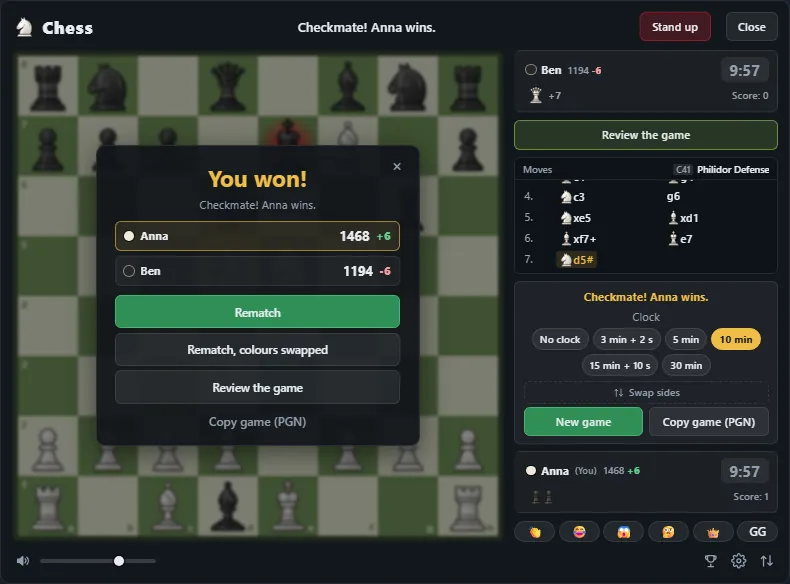
A card comes up on the board: who won, both ratings counting to where they now stand, and confetti for the winner.
The end of a game: the ratings, a rematch, the review.
* **Rematch** starts the next game at once for the player who started this one. The other player's Rematch asks them for it, and they see who asks.
* **Rematch, colours swapped** changes chairs first.
* **Review the game** has the computer judge every move. See [Game review](/organized-chaos-docs/chess/game-review.md).
* **Copy game (PGN)** puts the game on the clipboard, readable by any chess program.
ESC or × puts the card away. The same buttons stay beside the moves.
## Against the computer
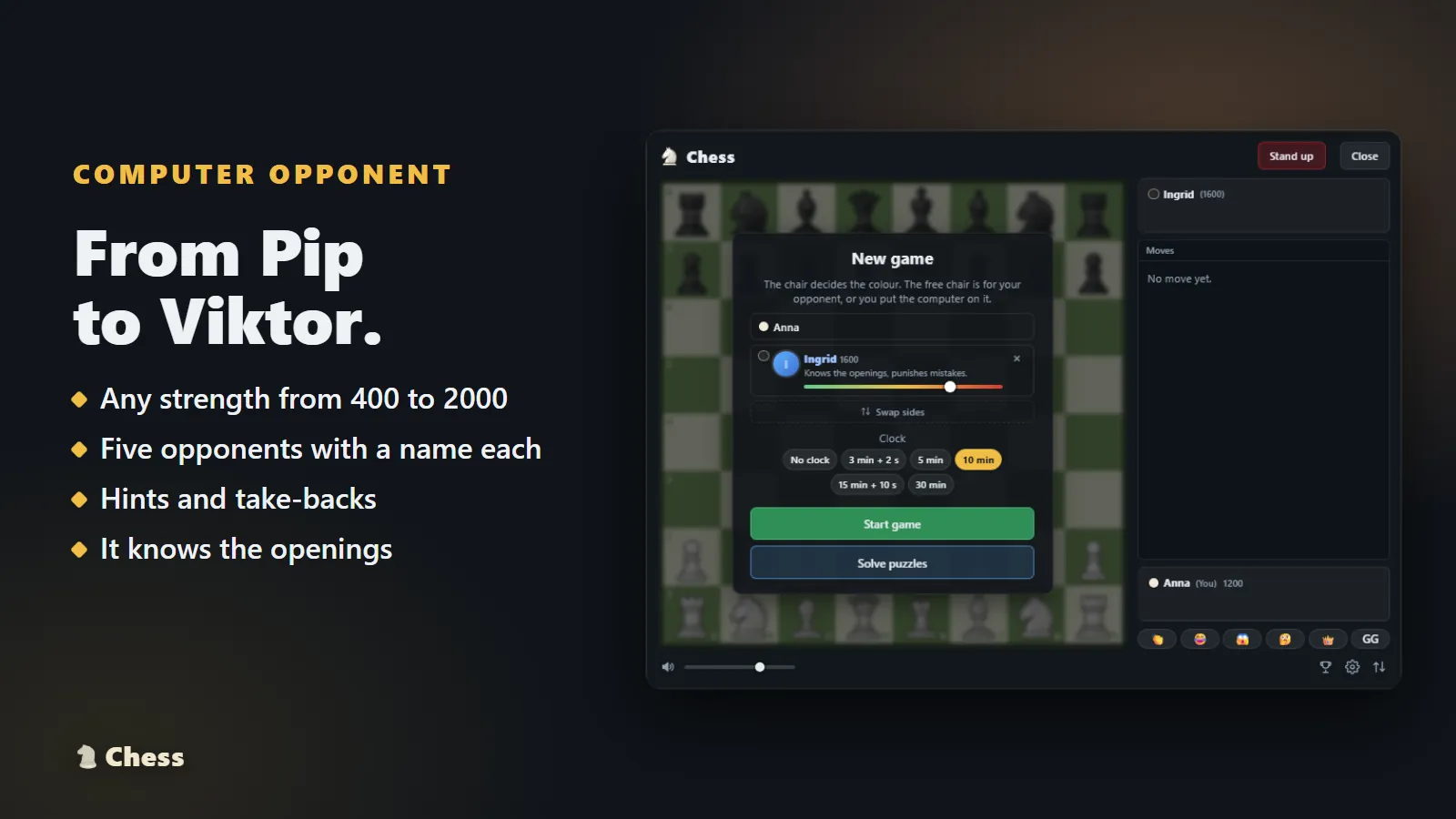
The player who starts the game puts the computer on the free chair with **+ Computer**, in the lobby and after every game, and sends it away again with **×**. To play Black, swap sides.
The computer's strength, set with a slider in the lobby.
Its strength is a rating from 400 to 2000, set with the slider under its name. With the strength the computer changes who it is:
| From | Who | How it plays |
| ---- | ------ | ------------------------------------------------------------------------------------------------------ |
| 400 | Pip | Looks at a few hundred positions, strays far from the best move and now and then plays any move at all |
| 800 | Rosa | Sees a little further, still strays a lot, blunders less |
| 1200 | Marco | Knows the common openings, a solid club player |
| 1600 | Ingrid | Looks at many thousand positions, strays little, punishes mistakes |
| 2000 | Viktor | Always plays the best move it finds, up to seven half-moves deep |
In between, everything moves smoothly with the rating. The names are set in `Config.BotPersonalities`.
Two aids exist against the computer only:
* **Take back** undoes your last move together with the computer's answer.
* **Hint** shows as an arrow what the strongest computer would play, once per move.
The computer accepts a draw offer when it is clearly worse. If the human stands up, the computer leaves too. Games against the computer are never played for money and are not rated.
## Watching
Anyone standing at a table opens the board with **G** and sees the game in progress. ESC closes it again.
Without opening anything, everyone standing around can follow the game on the **demo board** on its easel beside the table: the pieces, the last move, both players, whose move it is, and the result once it is over. See [Leaderboard and demo board](/organized-chaos-docs/chess/leaderboard.md).
## Losing the connection
A player who loses the connection in the middle of a game keeps the seat for two minutes (`Config.ReconnectTime`). After reconnecting they get a notice, and **E** at their own chair continues the game. Their clock keeps running in the meantime. If they are not back in time, the game is lost.
## At the table
The pieces on the table follow the game. The piece that moved slides to its new square. A captured piece stays until the other one has arrived, and is then set down in front of whoever took it. A chess clock stands beside the board, with the button of whoever has just moved pressed down. Whoever moves reaches across the board briefly, the computer's ped included. Between games the starting position stands on the board.
## Rules
The normal rules of chess apply, in full.
* Castling short and long, capturing en passant, promotion to queen, rook, bishop or knight.
* A game ends by **checkmate**, **resignation**, **running out of time**, or when a player leaves the table.
* **Draws** are stalemate, threefold repetition, the fifty-move rule, insufficient material on both sides, and agreement between the players. Repetition and fifty moves count by themselves. Nobody has to claim them.
* If the time runs out and the opponent could no longer mate with their material, the game is a draw instead of a loss.